
Rifle Bipods & Monopods







FAQs
Should I choose a rifle bipod or a monopod for my setup?
To choose between a rifle bipod or a monopod for your setup, think about whether you need front-end stability, rear support, or something light to carry in the field. A rifle bipod provides maximum stability for prone, bench or precision shooting. A rear monopod fits under the buttstock for fine elevation adjustments, while a standalone hunting monopod gives you a quick, lightweight rest when shooting standing or kneeling. Pairing a bipod with a rear monopod creates the steadiest overall shooting platform.
What’s the difference between a Picatinny, Arca and sling stud bipod?
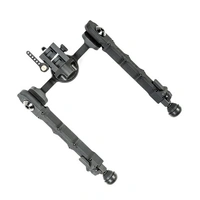
The difference comes down to how the bipod connects to your rifle. A Picatinny mount clamps onto a standard Picatinny rail, giving you a rigid, repeatable interface that suits multiple setups. An Arca mount clamps onto an Arca-Swiss rail, which is common on chassis rifles and lets you slide the bipod forward or back to fine-tune its position, plus swap quickly between your bipod and a tripod. A sling stud bipod attaches directly to the traditional swivel stud found on most standard hunting rifles, so it’s a simple option that needs no rail or extra hardware.
Is a swivel bipod better than a fixed bipod?
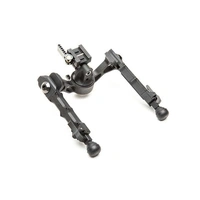
A swivel bipod is better than a fixed bipod if you often shoot on uneven ground, because it lets you tilt the rifle side to side to level your crosshairs. Some models also pan left and right so you can follow a moving target without shifting the bipod. A fixed bipod is simpler, with no extra movement, which suits flat ground and dedicated bench shooting.
Why do some rifle bipods cost under $100 while others are over $700?
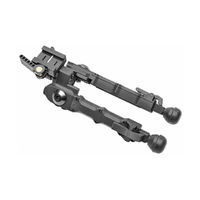
The reason some rifle bipods cost under $100 while others are over $700 comes down to materials, build quality and mechanical precision. Entry-level models provide dependable support for general hunting, whereas premium options from Accu-Tac and Atlas use high-grade machined aluminium and steel, tighter tolerances and specialised adjustments built for heavy-recoiling rifles and precision competition.
Are carbon fibre bipods worth considering over standard models?
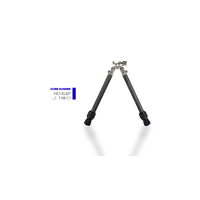
If keeping your rifle light is a top priority, carbon fibre bipods are well worth a look. Options from Huntsman and Leofoto shave weight off your setup for long days on foot, while still giving you a solid, steady rest. If you’re mostly shooting from the bench, a heavier aluminium or steel bipod can still be the better pick, since the extra mass adds stability.
How do I choose the right bipod height for prone, bench or field shooting?
To choose the right bipod height for prone, bench or field shooting, match the leg length to your shooting position and the ground cover around you. Shorter bipods of around 6 to 9 inches keep the rifle low and stable for prone shooting on open ground. Mid-height 9 to 13 inch models suit the bench and give you clearance over grass, rocks and uneven terrain. For shooting while sitting, look at taller models that extend to around 13 to 27 inches.